
The house edge is the share of each bet that a casino keeps on average over the long run. It is the single most useful number for comparing casino games, and it varies enormously: from zero on one craps bet to well over 10% on others. Here is a ranked reference table, with the rules each figure assumes.
The ranking
| Game and bet | House edge | Source of the figure |
|---|---|---|
| Craps: odds bet behind the line | 0% | Calculated: pays true odds |
| Blackjack, basic strategy | about 0.5% to 1% | Depends on rules; see notes |
| Baccarat: banker (5% commission) | 1.06% | Calculated, 8 decks |
| Baccarat: player | 1.24% | Calculated, 8 decks |
| Craps: don't pass | 1.36% | Calculated |
| Craps: pass line | 1.41% | Calculated |
| Roulette, single zero: any standard bet | 2.70% | Calculated |
| Online slots | typically about 3% to 6% | Varies by game: 100% minus the published RTP |
| Roulette, double zero: standard bets | 5.26% | Calculated |
| Craps: field (2 and 12 pay double) | 5.56% | Calculated |
| Roulette, double zero: five-number bet | 7.89% | Calculated |
| Baccarat: tie (8 to 1) | 14.36% | Calculated, 8 decks |
| Craps: any seven | 16.67% | Calculated |
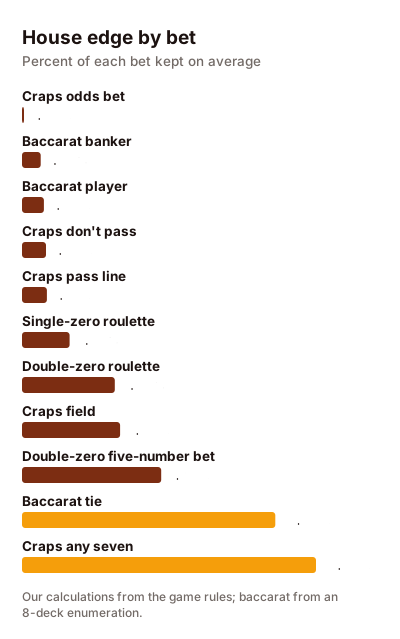
"Calculated" figures are our own exact calculations from the game rules. The baccarat values come from a full enumeration of an 8-deck shoe and match the figures commonly published. Rules vary between casinos; always check the table you play.
How the numbers are calculated
The house edge is the expected loss per unit staked. Two examples:
Worked example: Single-zero roulette, bet on red. Probability of winning 18/37, paying 1 to 1. Expected result per unit: 18/37 × 1 − 19/37 × 1 = −1/37, a house edge of 2.70%.
Craps pass line. The probability of winning is 244/495 = 49.29%. Expected result per unit: 0.4929 − 0.5071 = −0.0141, a house edge of 1.41%.
Notes on the rules
- Blackjack depends heavily on rules. Paying 6 to 5 instead of 3 to 2 for a blackjack adds about 1.4% to the house edge, and a dealer who stands on soft 17 instead of hitting cuts it by about 0.2%.
- Baccarat banker bets usually pay a 5% commission; tables with other commission rules have different edges.
- Slots do not have a single figure: each game has its own RTP, and some games come in several RTP versions.
Key point: The house edge says how much you lose on average per unit bet. How much you lose per hour also depends on how many bets you make: a low-edge game played very fast can cost more than a higher-edge game played slowly.
What the ranking does not tell you
- Variance. Two bets with the same edge can produce very different sessions.
- Speed. An online slot can play hundreds of rounds per hour.
- Your total. Expected loss = total amount bet × house edge. Betting more, or for longer, means losing more on average.
Watch out: No bet in this table has a positive expected value for the player. The odds bet in craps is the only one with no edge, and it can only be placed alongside a pass or don't pass bet, which has one.
Work out the cost of any roulette bet with the roulette odds and house edge calculator, and see Roulette Math: European vs American for the full breakdown.
- House edges range from 0% (craps odds) to over 16% (craps any seven).
- Banker in baccarat (1.06%), pass and don't pass in craps (about 1.4%) and single-zero roulette (2.70%) are among the lowest standard bets.
- Expected loss is the total amount bet times the house edge: speed and time matter as much as the game.
Sources
- Baccarat — Wikipedia: punto banco house edges
- Blackjack — Wikipedia: rules and house edge
- Craps — Wikipedia: bets and odds
18+ only. No betting system changes the house edge. See our Responsible Gambling page.

RTP Data explains the mathematics of casino games, with every figure sourced or worked out in the text.