
Two bets can share the same house edge and still feel like completely different games. On a single-zero roulette wheel, a bet on red and a bet on a single number both have a house edge of 2.70%. One wins almost half the time and pays even money; the other wins once in 37 spins and pays 35 to 1. This entry uses exact calculations to show what that difference does to a session.
Chance of finishing ahead
Betting 1 unit per spin on a single-zero wheel:
| Session | Even-money bet (red) | Single number (35 to 1) |
|---|---|---|
| 10 spins | 34.4% | — |
| 100 spins | 35.5% | 50.9% |
| 1,000 spins | 18.8% | — |
Our own exact calculations with the binomial distribution. "Ahead" means strictly more money than at the start; finishing level counts as not ahead.
Over 100 spins, a single-number bettor is more likely to be ahead than an even-money bettor: 50.9% against 35.5%. That sounds like a better bet. It is not: both lose 2.70% of the amount staked on average. The single-number bettor is ahead more often by a little, and behind by a lot when the hits do not come.
Key point: Volatility does not change the average; it changes the shape. High-volatility bets turn many small, steady losses into a mix of occasional big wins and frequent bigger losses.
The house edge wins in the long run
Even for the steadiest bet, time works against the player. With even-money bets, the chance of being ahead falls from about 35% after 100 spins to about 19% after 1,000. After 10,000 spins, it is about 0.3%, and the expected loss is 270 units.
Bankroll and the risk of going broke
How long a bankroll lasts depends on its size relative to the stake. Betting 1 unit on red every spin until the bankroll runs out:
| Starting bankroll | Broke within 100 spins | Within 500 spins | Within 1,000 spins |
|---|---|---|---|
| 10 units | 41.1% | 81.4% | 91.2% |
| 20 units | 7.7% | 58.4% | 79.0% |
| 50 units | under 0.1% | 8.5% | 34.5% |
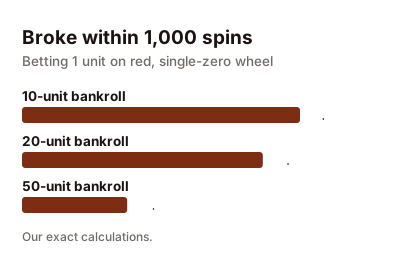
Worked example: Reading the table: with 20 units and 1-unit bets, there is a 7.7% chance of losing everything within 100 spins, but a 79% chance within 1,000. A bigger bankroll buys time, not a better outcome.
What this means in practice
- Smaller stakes relative to your budget make a session last longer, which is what most people actually want from it.
- Higher volatility raises the chance of a short-term win and the chance of a fast loss.
- Longer sessions move results towards the expected loss.
Watch out: None of these choices changes the expected loss: total amount bet × house edge. Set a budget and a time limit before you start, and stop when either runs out.
Calculate the cost of any session with the roulette odds and house edge calculator, and see Roulette Math: European vs American for the house edge itself.
- Red and single-number bets share a 2.70% house edge but produce very different sessions.
- After 100 spins, a single-number bettor is ahead 50.9% of the time, an even-money bettor 35.5%.
- More spins push results towards the expected loss; a bigger bankroll only delays it.
Sources
- Gambler's ruin — Wikipedia
- Binomial distribution — Wikipedia
18+ only. No betting system changes the house edge. See our Responsible Gambling page.

RTP Data explains the mathematics of casino games, with every figure sourced or worked out in the text.