
Craps looks chaotic, with dozens of bets on the layout, but all of it rests on one simple fact: two dice produce 36 equally likely combinations. Once you know how often each total appears, every bet on the table can be worked out exactly. This entry does the arithmetic.
The 36 combinations
| Total | Ways to roll | Probability |
|---|---|---|
| 2 | 1 | 2.78% |
| 3 | 2 | 5.56% |
| 4 | 3 | 8.33% |
| 5 | 4 | 11.11% |
| 6 | 5 | 13.89% |
| 7 | 6 | 16.67% |
| 8 | 5 | 13.89% |
| 9 | 4 | 11.11% |
| 10 | 3 | 8.33% |
| 11 | 2 | 5.56% |
| 12 | 1 | 2.78% |
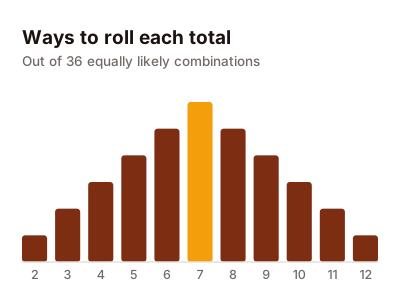
Seven is the most common total because it can be made in six ways: 1+6, 2+5, 3+4 and the reverse of each.
The pass line, step by step
On the first roll (the "come-out"):
- 7 or 11 wins immediately: 8 ways out of 36.
- 2, 3 or 12 loses immediately: 4 ways out of 36.
- Any other total becomes the point. The shooter keeps rolling until the point comes again (win) or a 7 appears (lose).
The chance of making a point before a 7 depends on the point:
| Point | Chance of rolling it before a 7 |
|---|---|
| 4 or 10 | 3 in 9 = 33.3% |
| 5 or 9 | 4 in 10 = 40.0% |
| 6 or 8 | 5 in 11 = 45.5% |
Putting it together, the pass line wins with probability 244/495 = 49.29%. Paid at even money, that gives a house edge of 1.41%.
Worked example: Why the point matters: if the point is 4, there are 3 ways to roll a 4 and 6 ways to roll a 7. Only those 9 outcomes end the sequence, so the chance of winning is 3 in 9. All other totals simply mean "roll again".
The odds bet: no house edge
Once a point is set, you can add an odds bet behind the pass line. It pays true odds: 2 to 1 on 4 or 10, 3 to 2 on 5 or 9, 6 to 5 on 6 or 8. Because the payout matches the probability exactly, the house edge on the odds bet is zero.
Key point: The odds bet is the only common casino bet with no house edge. It cannot be placed on its own, though: it always accompanies a pass or don't pass bet, which carries an edge of about 1.4%.
Bets to avoid
| Bet | House edge |
|---|---|
| Don't pass | 1.36% |
| Pass line | 1.41% |
| Field (2 and 12 pay double) | 5.56% |
| Any seven (pays 4 to 1) | 16.67% |
The "any seven" bet wins 1 in 6 times but pays only 4 to 1; a fair payout would be 5 to 1. The gap between the payout and the true odds is the house edge, and on some proposition bets it is very large.
Watch out: The colourful proposition bets in the centre of the layout carry the highest house edges at the table. Their big payouts reflect how rarely they win.
For the full comparison across casino games, see House Edge of Every Casino Game, Ranked.
- Two dice make 36 combinations; 7 is the most common total.
- The pass line wins 49.29% of the time, a house edge of 1.41%.
- The odds bet pays true odds and has no house edge; proposition bets have the highest.
Sources
- Craps — Wikipedia
- Expected value — Wikipedia
18+ only. No betting system changes the house edge. See our Responsible Gambling page.

RTP Data explains the mathematics of casino games, with every figure sourced or worked out in the text.